
Personal finance advice often follows a familiar formula: cover your expenses, build an emergency fund, invest consistently, and put every extra dollar to work.
On paper, it makes perfect sense. Money sitting in a bank account earns little compared with what a diversified investment portfolio might earn over the long term. The sooner you invest, the more time compound growth has to work in your favor.
But there is a problem with this approach.
You can be financially responsible, have a healthy emergency fund, own a growing investment portfolio, and still feel like you don’t have enough money to spend.
Not because you are broke. Not because you cannot afford something. But because all your money already has a job.
Your everyday income covers your bills. Your emergency fund is reserved for genuine emergencies. Your investments are for the future. Your savings are allocated to specific goals.
So where is the money you can simply use?
The Problem With Giving Every Dollar a Job
A well-organized financial system gives every dollar a purpose. You know how much you spend, how much you save, and how much you invest. You avoid unnecessary purchases and make deliberate financial decisions.
These are good habits. But taken too far, they can create a system in which spending money becomes unnecessarily complicated.
Imagine that you want to buy a new tool for $600. You can afford it. Your investments are growing, your emergency fund is intact, and your bills are paid.
Yet you hesitate.
The money in your emergency fund is not meant for this. Your investments are supposed to stay invested. Your savings are reserved for other goals. And your monthly spending allowance was not designed to accommodate this purchase.
Technically, you have the money. Practically, you don’t feel free to use it.
This is the downside of treating every dollar as either money to spend on routine expenses, money to save for a specific purpose, money to protect you from emergencies, or money to invest for the future.
A good financial plan should not only protect your future. It should also make your present life easier.
An Emergency Fund Is Not the Same as Spendable Cash
An emergency fund is an essential part of personal finance. It protects you against unexpected events such as losing your job, facing an urgent repair, or dealing with an unforeseen medical expense.
Its purpose is to provide financial security when something goes wrong.
But buying a useful tool, replacing an aging appliance before it fails, upgrading something that makes your daily life easier, or taking advantage of an opportunity is not necessarily an emergency.
You should not have to justify these purchases as emergencies just to feel comfortable using your money.
Nor should every such purchase require you to sell investments.
Investments have a different purpose. They help you build wealth over time, and selling them to cover ordinary purchases can disrupt your investment strategy. Depending on the investment, you might also face transaction costs, taxes, or an unfavorable selling price.
The solution is not to abandon investing or reduce your emergency fund.
It is to recognize that you can have money that is neither emergency money nor investment money.
Build a Cash Reserve You Are Free to Use
Call this a personal cash reserve: money that is available for ordinary, useful, or spontaneous spending without being assigned to a specific purchase in advance.
It sits alongside your emergency fund and investments.
You do not need to know exactly what you will spend it on. You do not need to spend it at all. Its purpose is to give you the freedom to act when a need or desire arises.
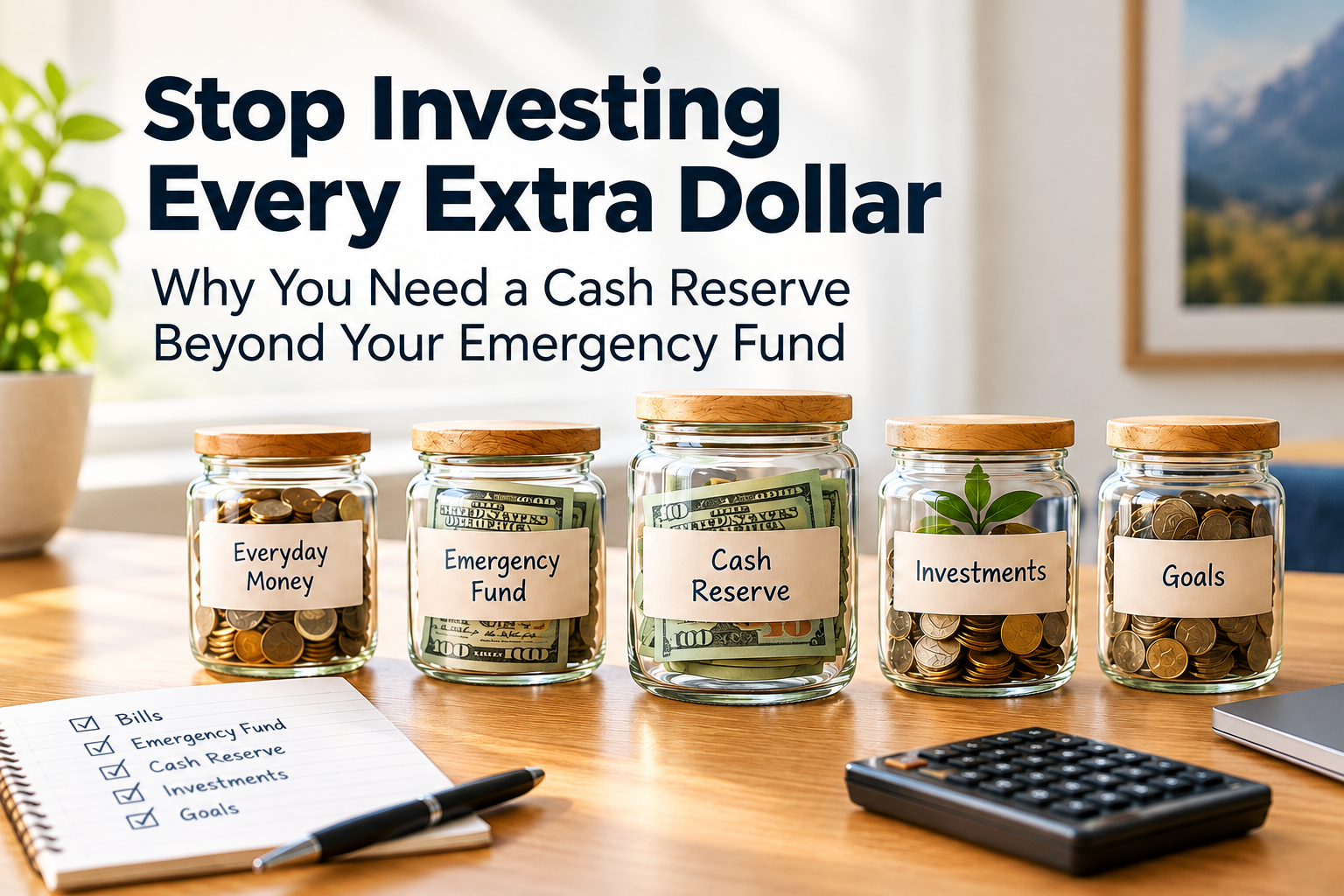
For example, imagine your financial system looks like this:
- Everyday money: Covers your regular bills and daily expenses.
- Emergency fund: Protects you against genuine financial emergencies.
- Cash reserve: Gives you the freedom to make purchases without disrupting the rest of your financial plan.
- Investments: Build long-term wealth.
- Goal-specific savings: Cover purchases and expenses you are already planning for.
Each category has a distinct role. The personal cash reserve fills the gap between money you have already committed and money you intend to invest for the long term.
You might start with a target of $500 or $5,000. The right amount depends on your circumstances, lifestyle, income, and the kinds of purchases you typically make. There is no universal number that works for everyone.
The important part is to choose an amount that gives you meaningful flexibility.
Spend It, Then Build It Back Up
The defining feature of this system is that the reserve is meant to be used.
Suppose you decide that your target reserve is $5,000.
You have the money available and want to buy a tool that costs $700. You buy it. Your reserve drops to $4,300.
Nothing has gone wrong. You have used your money for something worthwhile, and your emergency fund and investments remain untouched.
Over time, you direct some of your surplus income back into the reserve until it reaches $5,000 again.
Then the cycle continues.
You do not need to create a separate savings goal for every possible purchase. You do not need to predict every future need. And you do not need to feel guilty about spending money that you deliberately set aside to be spendable.
The reserve is not a second emergency fund. It is a standing pool of available money that you replenish after using it.
Of course, replenishment should fit your budget. If you repeatedly spend more than you can realistically replace, your target or spending habits may need adjusting. The point is to create sustainable flexibility, not an excuse to spend without limits.
Isn’t Keeping Cash Financially Inefficient?
In purely mathematical terms, holding additional cash can reduce expected long-term returns compared with investing that money. Cash can also lose purchasing power to inflation.
That trade-off is real, and it should not be ignored.
But maximizing expected investment returns is not the only legitimate financial objective.
Money also provides liquidity, flexibility, convenience, and peace of mind. It allows you to make decisions without selling assets at an inconvenient time or reassessing your entire financial plan every time you need to buy something.
Think of it as paying for flexibility.
You would not necessarily invest the money you need for next month’s bills simply because investments might generate a higher return. The same principle can apply to a reasonable reserve for everyday financial freedom.
The question is not whether cash can outperform investments over the long term. Generally, it is not expected to. The question is how much you value having money readily available and what amount is enough to provide that benefit.
A $5,000 reserve may be worthwhile for one person and excessive for another. Your income, financial obligations, investment portfolio, and personal preferences all matter.
The objective is not to accumulate as much cash as possible. It is to find a balance between growing your wealth and having access to it.
Stop Treating Every Uninvested Dollar as a Mistake
There is a difference between accumulating cash without a reason and deliberately maintaining a cash reserve.
The first can happen through indecision or avoidance. The second is a conscious financial choice.
If you already have a suitable emergency fund, have accounted for planned expenses, and invest consistently toward your long-term goals, you do not necessarily need to invest every additional dollar immediately.
You can decide that a certain amount of money will remain available for whatever life brings.
That money might pay for a useful tool, an unexpected opportunity, a quality-of-life improvement, or something you simply want. You might use it next week, next month, or not for a long time.
You do not have to invent a purpose for it in advance.
And you do not have to optimize every last dollar.
Financial Security Should Include Financial Freedom Today
Personal finance is often presented as a choice between spending now and building wealth for later. But a sustainable financial system should make room for both.
Your emergency fund protects you from serious setbacks. Your investments help you build long-term wealth. Your goal-specific savings prepare you for known expenses.
A cash reserve serves a different purpose: it allows you to use the money you have without constantly disturbing those other plans.
You can be disciplined about saving and investing while still keeping money available to spend. You can care about long-term returns without making every purchase feel like a financial failure.
The goal is not to make every dollar work as hard as possible. The goal is to build a financial life that works for you.
Sometimes, the smartest thing you can do with a little extra money is keep it available — so that when you need it, you can simply use it.