
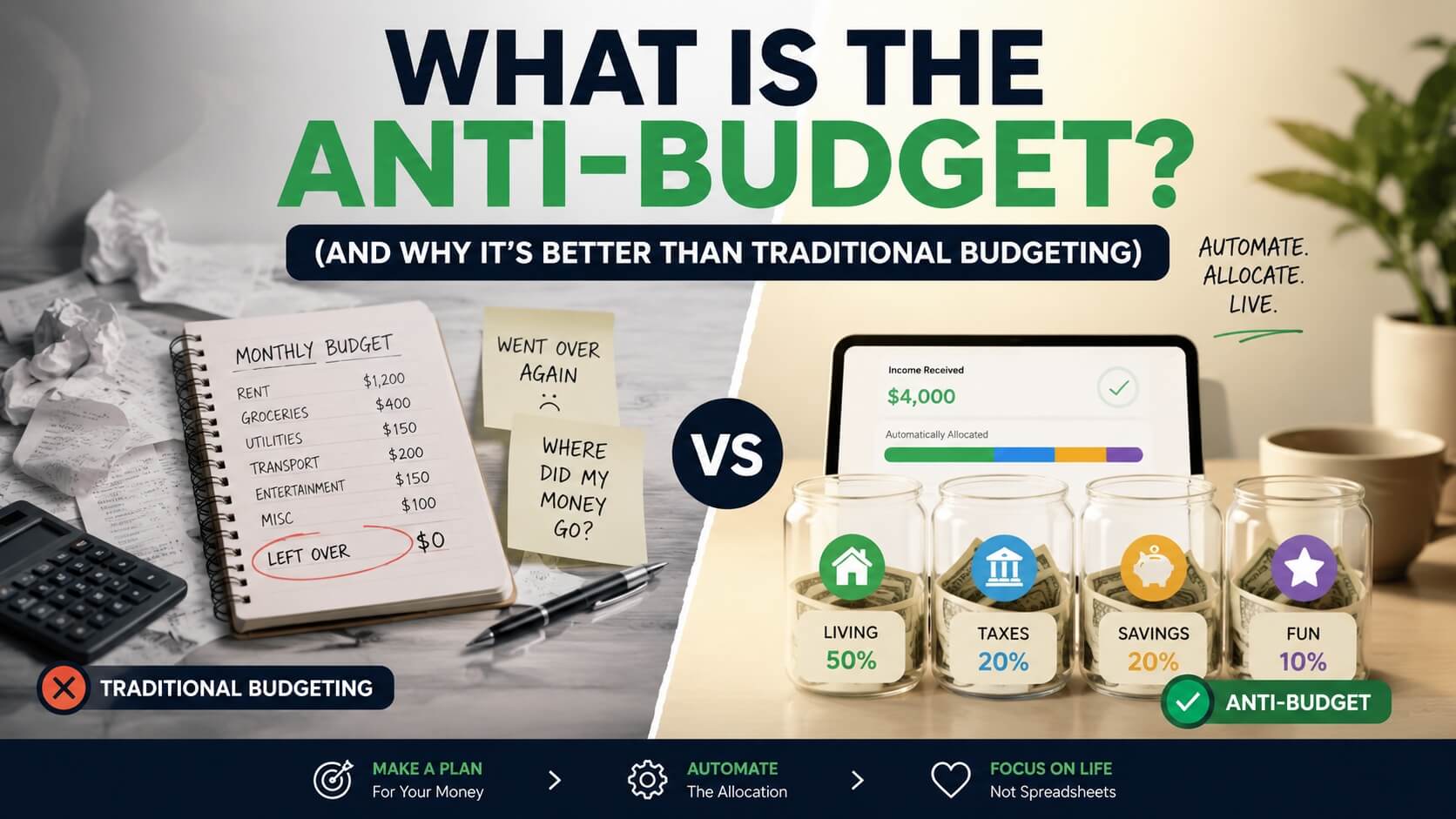
We’ve all been told the same lie about personal finance: If you want to get rich, you need to track every single penny you spend.
So, you download a budgeting app. You link your bank accounts. You create twenty or forty different spending categories—Groceries, Coffee, Entertainment, Transport, and things you don’t even know how to classify. For the first two weeks, you feel like a financial genius.
By week three, you forget to log a few cash purchases. By week four, the app sends you an aggressive notification because you went $15 over your “Dining Out” limit. You feel restricted, stressed, and guilty.
So, you quit. And your finances go right back to where they started.
The problem isn’t your lack of discipline. The problem is the system. Traditional budgeting is fundamentally broken because it focuses on micro-managing the past instead of automating the future.
There is a better way. It’s called the anti-budget.
What is the Anti-Budget?
The anti-budget (often called the “Pay Yourself First” method) is an aggressively minimalist budgeting strategy. Instead of tracking what goes out of your bank account, you only track what goes in and redirect a fixed percentage toward your goals immediately.
How the Anti-Budget Works
When money hits your account, your monthly Anti-Budget cash flow will look like this:
The Anti-Budget Cash Flow
1. Income
Calculate the total of all your monthly income sources.
2. Expenses
List your fixed, non-negotiable expenses that keep your life running.
3. Savings
Determine the money you immediately lock away to secure your goals.
4. Free to Spend
The rest is meant for guilt-free spending all the way to zero—just make sure this amount is sufficient to cover your daily life.
This redistribution of your income ensures every dollar has a clear, deliberate purpose before you even start spending.
Putting the Anti-Budget Into Practice
Now that your numbers are clear, execute the Anti-Budget system immediately as follows:
1. Pay Your Expenses First
Set your listed bills on autopay so they clear without your manual effort.
2. Move Your Savings Away
Instantly transfer your determined savings to a separate account or investment portfolio before you touch anything else.
3. Spend the Rest to Zero
Leave the remaining balance in your main account. This is your “Free to Spend” fund for the month—no tracking, no guilt, just pure freedom.
After taking care of your fixed costs and savings goals, the remaining money is yours to spend as you please—whether it’s food, shopping, personal care, or fun.
The Anti-Budget Formula
As you see, the entire system runs on one single, elegant formula:
Income – Expenses – Savings = Free to Spend
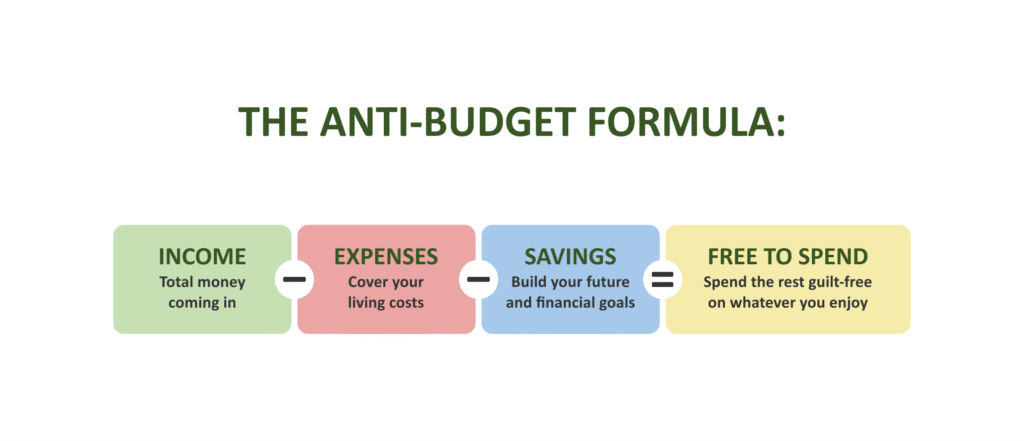
Traditional budgeting focuses on micro-managing what you spend. The Anti-Budget focuses entirely on controlling your Savings upfront. Once your fixed survival costs (rent, bills) are covered and your savings goals are secured, the remaining balance is yours to destroy guilt-free.
So basically, you live paycheck-to-paycheck—but under this system, that is exactly the goal. Normally, living from paycheck to paycheck means stress, survival, and zero control. Here, it means absolute freedom. The moment your money hits your account—whether you get paid once, twice, or bi-weekly—your bills are covered, and your savings are set aside immediately. Your future is secured first. That means every single dollar left over is meant to be spent. You can legally drain your account to absolute zero before the next payday with zero guilt, zero stress, and zero tracking. It’s not reckless; it’s just how the system is designed to work.
Traditional Budgeting vs. The Anti-Budget
| Traditional Budgeting | The Anti-Budget |
| Focus: Micro-managing expenses | Focus: Maximizing savings/investments |
| Process: Log every receipt | Process: Transfers per paycheck |
| Mindset: Scarcity, restriction, guilt | Mindset: Abundance, freedom, clarity |
| Time required: Hours every week | Time required: Minutes per paycheck |
How the Anti-Budget Works (The 3-Step Framework)
The reason the Anti-Budget works so well is that it requires almost zero willpower. Once you set it up, the system runs on autopilot. Here is how it breaks down:
Step 1: Define Your Financial Goals
Instead of deciding how much you are “allowed” to spend on clothes, you decide how much you want to save and invest. For most people, a healthy baseline is 20% of their net income, but you can start with whatever number moves the needle for you. This goes toward:
- Your emergency fund (liquid cash)
- Long-term investments (stocks, ETFs, crypto, or real estate)
- Specific short-term goals (travel, a house down payment)
Step 2: “Pay Yourself First” (Automate It)
The day your income hits your bank account, your predetermined savings percentage is automatically transferred out. It goes straight to your investment broker or your separate savings accounts.
You don’t wait until the end of the month to see “what’s left” to save. What’s left is usually zero. You save first.
Step 3: Guilt-Free Spending
This is where the magic happens. Once your fixed expenses (rent, utilities, insurance) are covered and your savings goals are met, the money left in your checking account is 100% play money.
Do you want to spend all of it on fine dining? Go ahead. Do you want to buy an expensive gadget? Do it. You don’t need to check an app to see if it “fits your budget.” Your savings goals are already secured. The rest of the money has no job other than to be spent.
Why the Anti-Budget is Objectively Better
1. It Eliminates Decision Fatigue
The average person makes dozens of micro-decisions a day. Adding financial guilt to every coffee order drains your mental energy. The Anti-Budget turns financial management into a single binary decision: Did I hit my savings goal this month? If yes, you win.
2. It’s 100% Private and Independent
Many modern budgeting apps sell your aggregated data to third-party advertisers. They require complex bank syncing that constantly breaks. The Anti-Budget doesn’t care about your specific bank API—it works on pure logic that you control, keeping your financial life entirely private.
3. It Focuses on the Levers That Actually Matter
Skipping a $4 latte will not make you wealthy. Increasing your investment rate from 10% to 25% will. The Anti-Budget forces you to look at the big picture—your net worth growth—rather than arguing over minor grocery expenses.
4. It Saves You Time
Traditional budgets turn you into a part-time accountant. The Anti-Budget could only take minutes a month—just set it, net it, and forget it.
Stop Micro-Managing. Start Automating.
If you are tired of complex dashboards, monthly app subscriptions, and constant financial anxiety, it’s time to ditch the traditional budget.
We built the AntiBudget Spreadsheet to streamline this exact process. No charts, no categories, no subscriptions. Just a clean, minimalist Excel and Google Sheets framework that takes a few minutes a month to manage, giving you total clarity over your wealth-building journey.
Stop tracking every coffee. Focus on the big picture.
[Get the AntiBudget Spreadsheet today and automate your financial freedom. ]