
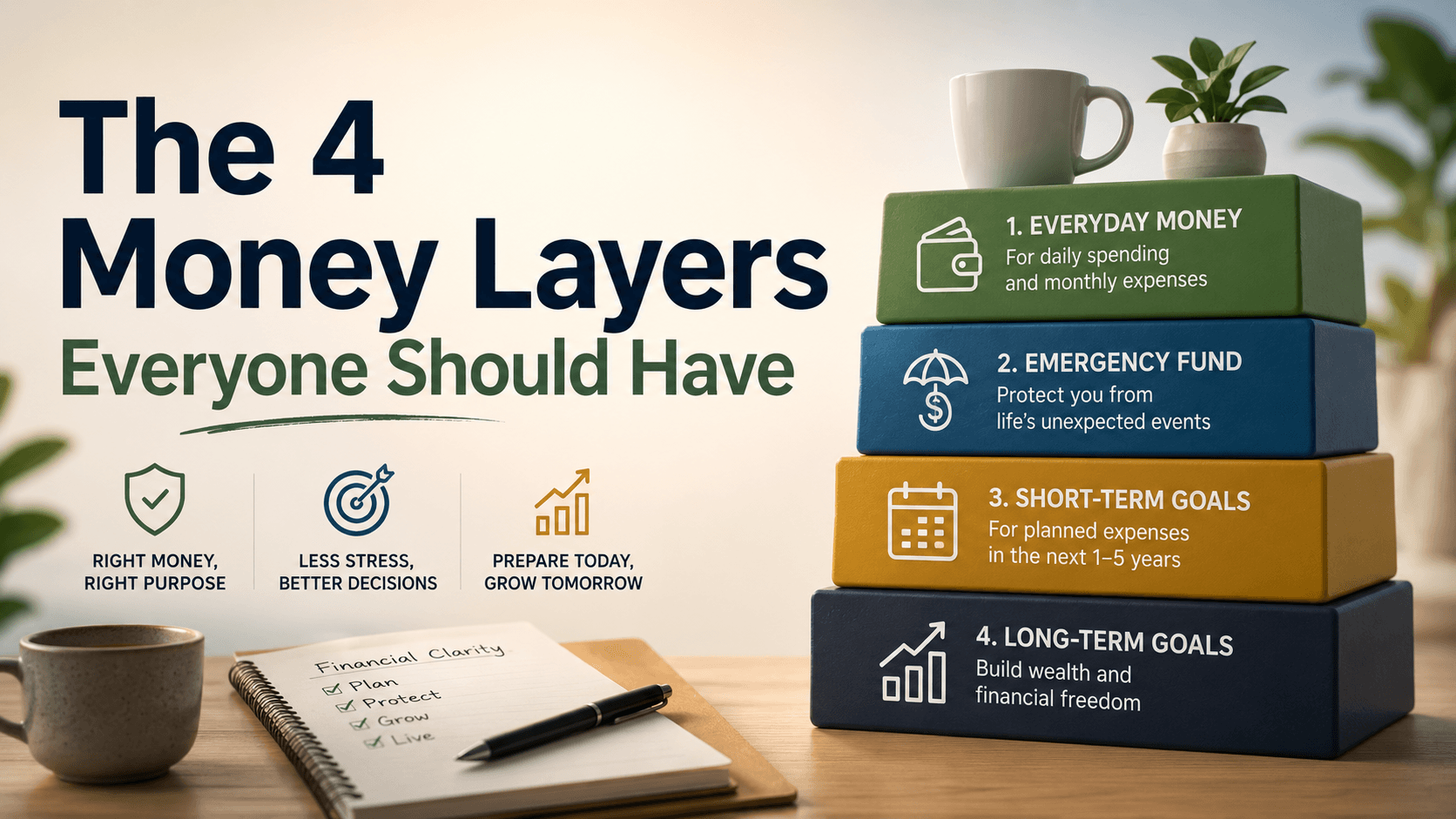
Many people either keep too much money sitting in a bank account or invest money they may need too soon.
A simpler approach is to divide your money into layers.
Each layer has a different purpose, time horizon, and level of risk.
This creates clarity, reduces stress, and helps prevent emotional financial decisions.
1. Everyday Money
This is the money used for normal monthly life:
- rent or mortgage,
- groceries,
- bills,
- subscriptions,
- transportation,
- and daily spending.
Usually, this stays in a checking account for easy access.
The goal is not growth.
The goal is convenience and liquidity.
A good rule is to keep enough cash to comfortably cover:
- monthly expenses,
- upcoming bills,
- and a small buffer for unexpected spending.
2. Emergency Fund
An emergency fund exists to protect you from financial shocks.
Examples include:
- job loss,
- medical expenses,
- car repairs,
- home repairs,
- or other unexpected emergencies.
This money should be:
- separate from your everyday spending account,
- easy to access,
- and stable in value.
Many people keep their emergency fund in:
- a high-yield savings account,
- a savings account,
- or short-term deposits.
How Much Should You Keep?
A common recommendation is:
- 3–6 months of essential living expenses.
However, the right amount depends on your situation:
- job stability,
- monthly expenses,
- family responsibilities,
- debt levels,
- and number of income sources.
Someone with low expenses and stable income may feel comfortable with a smaller emergency fund.
Someone with a mortgage, children, or variable income may prefer a larger one.
3. Short-Term Goals
This layer is often overlooked.
Short-term goals are expenses planned within roughly the next 1–5 years.
Examples include:
- a house down payment,
- buying a car,
- home renovations,
- starting a business,
- education,
- travel,
- wedding,
- or major purchases.
This money is in an awkward middle zone:
- too important to risk heavily in volatile investments,
- but too long-term to leave entirely idle in a checking account.
Because of this, many people choose lower-risk options such as:
- savings accounts,
- deposits,
- bonds,
- money market funds,
- or conservative investment allocations.
The closer the goal is, the less risk most people want to take.
4. Long-Term Goals
This is money that is not needed for many years.
Its purpose is long-term wealth building.
Examples include:
- retirement investing,
- dividend portfolios,
- index funds,
- stocks,
- or other long-term assets.
Unlike emergency savings or short-term goals, this money can tolerate market volatility because time allows investments to recover from downturns.
Historically, long-term investing has been one of the best ways to:
- grow capital,
- fight inflation,
- and build financial independence.
Why This Layer Matters
Money sitting in cash for years slowly loses purchasing power due to inflation.
Meanwhile, long-term investments give your money the opportunity to compound over time.
That does not mean investing everything.
It means understanding which money needs safety and which money needs growth.
A Simple Financial Structure
Here is what the full system may look like:
| Time Horizon | Purpose | Typical Location |
|---|---|---|
| Up to 1 month | Everyday Money | Checking account |
| 3 months to 1 year | Emergency Fund | Savings account / deposits |
| 1–5 years | Short-Term Goals | Lower-risk savings and investments |
| 10+ years | Long-Term Goals | Stocks / index funds |
Each layer solves a different problem.
When your money has a clear role:
- spending becomes easier,
- investing becomes calmer,
- and financial decisions become more intentional.
Instead of asking:
“Should I keep cash or invest everything?”
you start asking:
“What is this money actually for?”
That is usually the more important question.